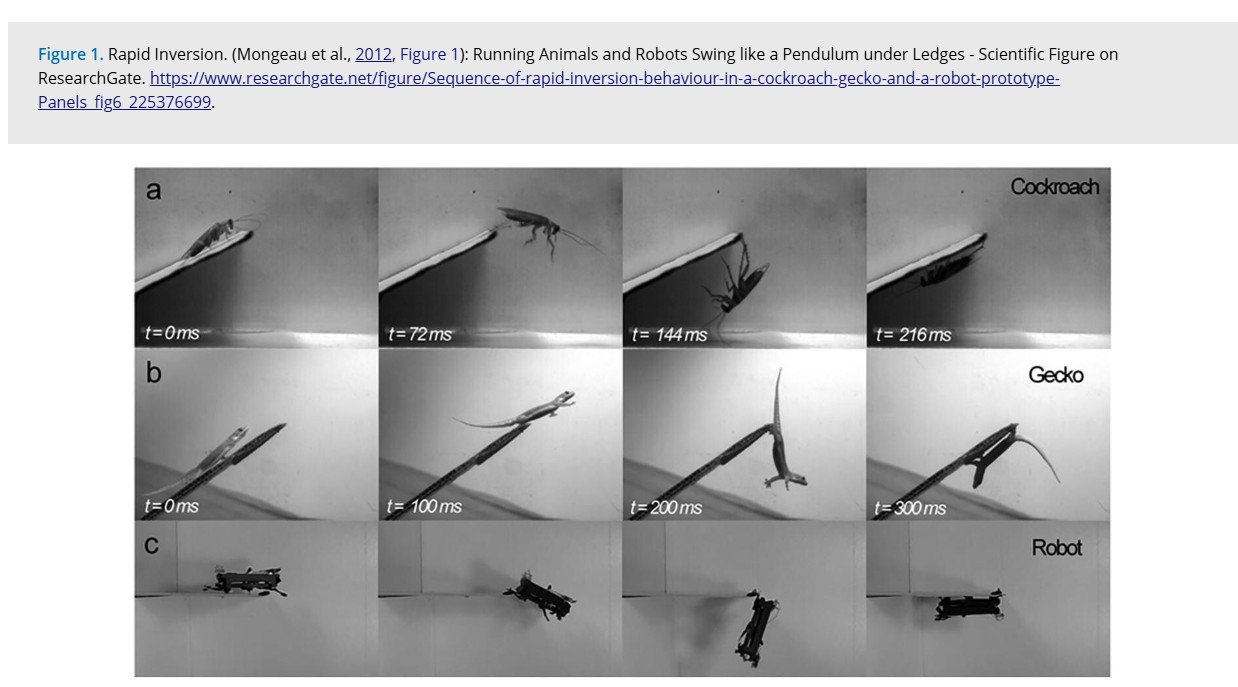
Picture this: A gecko or a cockroach is sprinting frantically up an incline, escaping a hungry predator. They reach the edge of a ledge at full tilt—and instead of stopping or flying off blindly, they dive right over. But they don’t fall. In a fraction of a second, their feet latch onto the underside of the ledge like a grappling hook, swinging like a pendulum to vanish completely out of sight.
To their predators, it’s a baffling disappearing act. To evolutionary biologists and robotics engineers, this breathtaking spatial maneuver is known as Rapid Inversion. In fact, as shown in the research, scientists didn’t just observe this trick in nature—they used it as biological inspiration to program a tiny, hexapedal search-and-rescue robot (equipped with little Velcro “claws”) to successfully perform the exact same death-defying swing. It relies entirely on how these systems interact with the physical geometry of their environment.
Rooted in James J. Gibson’s theory of affordances, space is fundamentally defined not as a blank, neutral Cartesian grid, but as what the environment offers or furnishes us—a place to be at a point in time, perceived with our eyes or our minds’ eyes. This brings us to a deeper look at how our interactions with landscapes have shaped our survival:
- 1. Species-Specific Spatial Survival: How each species responds to space is entirely unique to its own survival mechanics. While a gecko or cockroach relies on Rapid Inversion to flip beneath a ledge and vanish from a predator’s expectations, a tree-dwelling primate navigates complex canopies by extracting the structure of branches on the fly. (Fun fact: It is an incredible piece of evolutionary copycatting that two completely unrelated creatures—lizards and cockroaches—independently hit upon the exact same high-speed stunt to cheat death!) Space isn’t a neutral canvas; it is a dynamic toolbox tailored by evolution to keep each unique creature alive.
- 2. From Environmental Perception to Evolutionary Instinct: How we perceive and respond to our surroundings dictates our survival in the physical landscape. When these interactions prove successful generation after generation, they cease to be mere learned behaviors—they get coded directly into our instincts through evolutionary selection. Just as place cells in the hippocampus and grid cells in the entorhinal cortex form an internal mapping system in our brains, our deep-seated affective preferences for specific landscape compositions—what can be termed landskiphilia—are inherited blueprints of what once kept our ancestors safe, fed, and sheltered. Through the abstraction and extraction of landscape features into long-term collective memory, our psychological responses have co-evolved with our survival.
- 3. The Imperative for Space Designers and Makers: To build truly restorative environments, space designers and makers must understand these first two points. Modern urban spaces and wellness designs cannot rely on superficial green aesthetics or outdated single-motifs like the savannah hypothesis alone. By understanding how our brains and bodies instinctively read space, geometry, and affordances, designers can move beyond simple mitigation to true regenerative design—crafting built environments that actively resonate with our evolutionary psychology to foster human health, cognitive resilience, and deep well-being.
“As designers, planners, and creators, how can we intentionally weave these deep evolutionary ‘blueprints’ into our urban landscapes—not just to look green, but to make our minds and bodies truly feel at home?”